


.svg)

What Is Fascial Stretch Therapy? Understanding Assisted Stretching That Actually Works
Discover fascial stretch therapy and how assisted stretching improves mobility where conventional methods fail. Complete guide to FST benefits and techniques.
Your hip won't squat deeper, no matter how much you stretch. Your shoulder mobility hasn't improved despite months of foam rolling. You warm up for 20 minutes before training and still feel tight. So you stretch more, roll more, and wonder why nothing changes.
Here's why: the restrictions limiting your movement exist in tissue layers that foam rolling and static stretching can't reach. Your joint capsule is restricted. Your deep fascial planes have lost their ability to glide. And no amount of holding a stretch for 30 seconds will change that because you're targeting the wrong tissue.
Fascial stretch therapy addresses the actual source of your mobility restrictions through assisted stretching techniques that access joint capsules and fascial layers conventional methods can't touch. If you've been stuck with the same movement limitations despite consistent stretching, this might explain why everything you've tried hasn't worked.
Understanding Fascial Stretch Therapy
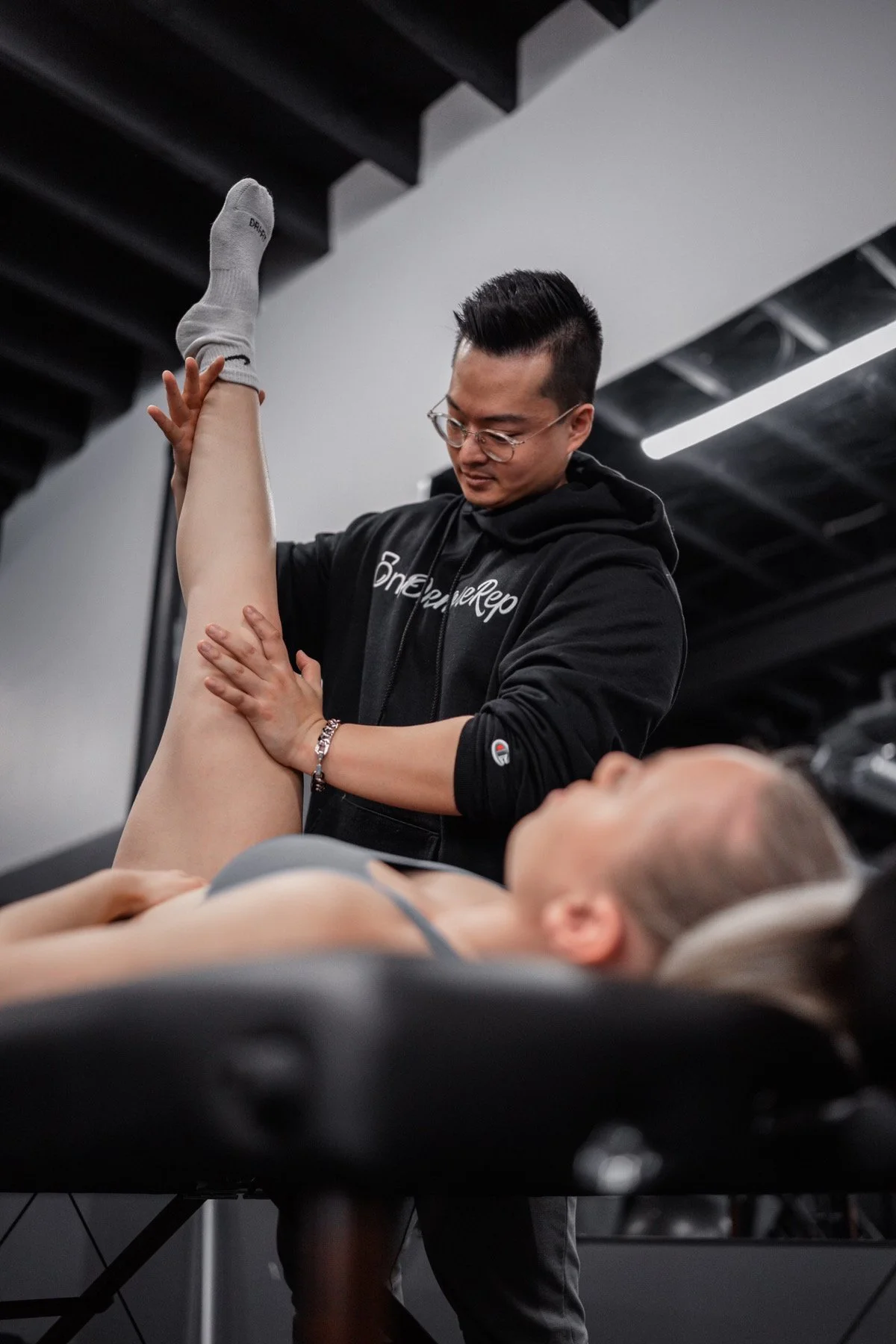
Fascial stretch therapy is a specialised form of assisted stretching performed by a certified therapist on a treatment table. Unlike conventional stretching, which primarily targets muscles, this approach uses traction and specific movement patterns to mobilise joint capsules and the fascial system – the connective tissue network surrounding every structure in the body.
Here's how it works: you lie on a treatment table while the therapist uses stabilisation straps to anchor portions of your body. This creates traction in your joints – essentially creating space in the joint capsule. While maintaining that traction, the therapist guides your limbs through specific movement patterns that target fascial planes and joint restrictions.
The key difference from regular stretching is the traction component. Your joint capsule contains some of the densest, most restriction-prone tissue in your body. When it's restricted, it limits your range of motion regardless of how flexible your muscles are. This therapy creates space in that capsule while moving through the restriction, accessing tissue layers you simply cannot reach on your own.
Sessions typically run 60 minutes and follow systematic sequencing – working from your core outward, addressing proximal restrictions before distal ones. This isn't random. Because your fascial system is continuous throughout your body, restriction in your thoracic spine can limit shoulder mobility, and hip restrictions can affect your ankle range.
Why Regular Stretching Stops Working
Most people discover assisted stretching techniques like fascial stretch therapy after months of conventional stretching that produced minimal lasting improvement. You hold stretches for 30 seconds. You do yoga twice a week. You foam roll before training. And you're still tight.
This happens because conventional stretching primarily affects muscle tissue and superficial fascia. When you hold a static stretch, you're creating tension in the muscle belly and its immediate fascial covering. This can temporarily improve flexibility, but it doesn't address deeper restrictions in joint capsules or fascial planes between muscle groups.
Your fascia exists in multiple layers that need to slide past one another during movement. When these layers lose their ability to glide – through repetitive movement patterns, inflammation, injury, or simple mechanical stress accumulation – you develop restrictions that static stretching can't resolve. You're stretching the surface while the restriction exists several layers deeper.
Joint capsule restrictions are even more problematic. The capsule surrounds your joint and contains extremely dense connective tissue. When it's restricted, it mechanically limits how far your joint can move. No amount of muscle stretching changes this because the restriction isn't in your muscle – it's in the joint structure itself.
What Sessions Actually Feel Like
Experiencing this type of therapy is completely different from conventional stretching, and most first-time clients are surprised by several aspects of the treatment.
You remain completely passive throughout the session. You're not actively stretching or pushing into ranges. Your job is to relax and breathe while the therapist does the work. This passivity is crucial – when you actively contract muscles during stretching, you engage protective mechanisms that limit the depth and effectiveness of the stretch.
You'll feel deep stretch sensations, but you shouldn't feel pain. There's a difference between the discomfort of tissues being taken to their current end range and sharp pain that indicates you're pushing too hard. A skilled therapist works at the edge of your available range, using breathing and small oscillations to progressively expand that range without triggering protective muscle guarding.
The traction component creates unique sensations. When the therapist creates space in your hip or shoulder joint, you feel a pulling or decompression sensation that's distinctly different from muscle stretching. Many clients describe this as feeling like their joint is "opening up" or gaining space – which is exactly what's happening.
Most people notice immediate differences after their first session. You might feel "looser" generally, or notice that specific movements feel easier or less restricted. Your squat depth might improve. Your shoulder might have more overhead range. These immediate changes reflect your nervous system's response to expanded movement patterns. The more significant structural changes develop over multiple sessions as your fascial tissue remodels in response to consistent mechanical input.
Who Actually Benefits Most
While anyone can benefit from improved mobility, certain populations see particularly significant results because their mobility restrictions are specifically suited to what this therapy addresses.
Strength Athletes and Lifters: Your squat depth is limited by hip capsule restrictions, not tight hip flexors. Your overhead press is compromised by thoracic spine immobility. Your deadlift setup suffers from limited ankle dorsiflexion. These restrictions create compensations that eventually lead to injury or plateau. This therapy addresses the actual joint and fascial restrictions limiting your lifting mechanics, often producing improvements that strength training alone cannot create.
People Over 35 Managing Age-Related Stiffness: You've noticed that warming up takes longer than it used to. Certain movements feel progressively more restricted. You're not as flexible as you were in your 20s, and stretching doesn't seem to help anymore. Age-related mobility changes largely reflect accumulated fascial restrictions and joint capsule limitations. Your tissue still responds to intervention – it just requires techniques that actually reach the restricted layers.
Endurance Athletes with Chronic Tightness: You run 40 miles per week and your IT band is perpetually tight. Your hips feel restricted. Your calves never seem to fully loosen up despite constant rolling and stretching. Repetitive movement creates predictable fascial restrictions and compensations. This therapy addresses these restrictions in ways your self-care routine cannot, often resolving chronic tightness that you've been managing unsuccessfully for months or years.
Anyone with Stubborn Movement Restrictions: You've tried everything – stretching, yoga, foam rolling, massage, strengthening exercises. Nothing produces lasting improvement. Your tight hips still limit your squat. Your restricted shoulders still affect your overhead work. When conventional approaches fail repeatedly, the restriction likely exists in tissue layers those methods can't access.
How This Differs from Other Mobility Work
Static stretching primarily affects muscle tissue and superficial fascia. You create tension through prolonged holds, but this doesn't address joint restrictions or create the traction necessary for capsular mobilisation.
Foam rolling provides self-myofascial release by creating pressure on tissue. This can improve tissue quality and reduce muscle tension, but it doesn't address joint restrictions or access the deeper fascial planes that assisted stretching techniques can reach.
Massage therapy manipulates soft tissue to reduce tension, improve circulation, and address trigger points. Excellent for muscle-related issues, but doesn't specifically target joint capsules or use traction-based techniques for fascial mobilisation.
None of these methods are bad – they're just different tools targeting different tissue layers through different mechanisms. This therapy isn't necessarily better than these approaches – it's better for the specific restrictions it targets: joint capsule limitations and deep fascial restrictions that other methods don't effectively address.
What to Expect During Your First Session
Your first session begins with assessment. The therapist needs to see how you currently move, where restrictions exist, and what compensations you've developed. This might include basic movement screens, range of motion testing, and discussion of your training, injury history, and specific limitations you've noticed.
You'll spend the session on a treatment table wearing comfortable athletic clothing that allows full movement. The therapist uses stabilisation straps – typically around your hips and the leg not being worked – to anchor your body and create the traction necessary for effective stretching.
Treatment typically follows systematic sequencing. Most sessions start with your core and hips before moving to extremities. This isn't random – restrictions in your thoracic spine and hips affect everything downstream. Addressing these foundational areas first ensures improvements in your shoulders or ankles actually hold rather than being limited by proximal restrictions.
Each joint or region is taken through specific patterns while traction is maintained. The therapist guides your limb through movements while you remain passive and focus on breathing. You'll feel deep stretch sensations, potentially some discomfort at end ranges, but never sharp pain that indicates tissue damage or excessive force.
How Often You Actually Need It
Frequency recommendations depend on your goals, current restrictions, and how quickly your tissue responds to treatment. If you're addressing significant restrictions or chronic mobility limitations, weekly sessions for 8-12 weeks typically produce optimal results. This frequency allows your nervous system to integrate new movement patterns and gives your fascial tissue adequate stimulus for remodelling.
Once you've addressed primary restrictions and achieved baseline mobility improvements, transitioning to bi-weekly or monthly sessions maintains your progress. Your tissue has adapted, but consistent mechanical input prevents restrictions from redeveloping.
Athletes preparing for competition or people with demanding training schedules might benefit from weekly sessions even after addressing initial restrictions. Regular sessions support recovery, maintain optimal movement quality, and help prevent the compensations that develop under high training loads.
The key factor is consistency. Sporadic sessions produce temporary improvements that fade. Regular sessions create progressive adaptations as your nervous system integrates new movement patterns and your fascial tissue remodels. Think of it like strength training – one workout doesn't build lasting strength, and one stretch session doesn't create lasting mobility change.
Ready to Address Your Mobility Restrictions?
Understanding assisted stretching techniques is the first step. Actually experiencing how they address restrictions that conventional stretching hasn't resolved requires working with a certified therapist who can assess your specific limitations and apply appropriate techniques.
Your free consultation includes movement assessment, discussion of your specific restrictions and goals, and honest evaluation of whether this approach addresses your needs or if different methods might be more appropriate.
Apply for Coaching
This form helps determine whether our coaching fits your goals, history and availability.



Take the First Step
As the owner and head coach of One More Rep in London, Ontario, with a decade of experience, I've worked with hundreds of clients with diverse objectives and capacities. The common factor isn't age, fitness level, or training history – it's willingness to follow programs consistently rather than seeking entertaining workouts.
.svg)
Apply for Coaching
This form helps determine whether our coaching fits your goals, history and availability.



Personal Training | Fascial Stretch Therapy | Fitness Test Prep | Voted Best Trainer 2024-2026
